

The Art of Microblasting
March 23, 2026
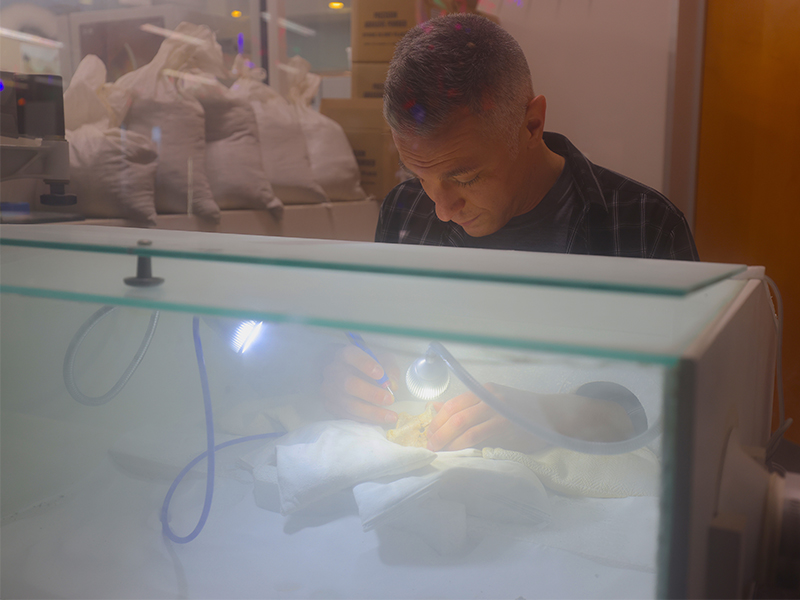
In a small room at the left edge of the third-floor Paleontology Research Lab (NRC), you may notice someone working inside a clear, enclosed box. Peering through a microscope, fossil preparators guide a small compressed-air pen that directs a fine stream of sodium bicarbonate (baking soda) onto the surface of a dinosaur bone.
This is often referred to as a “final detail pass” — a stage of preparation focused on revealing the finest anatomical features without altering the fossil itself. The technique is known as air abrasion, or by its cooler-sounding name, microblasting. Think of it as a highly controlled, gentler version of sandblasting.
Preparators use sodium bicarbonate because it is softer than fossil bone but firm enough to selectively remove surrounding sediment efficiently when used carefully. Because every fossil and sediment type behaves differently, pressure settings and nozzle distance must be carefully adjusted throughout the process to balance efficiency with preservation. The enclosed box helps contain the powder and debris created during the process, while an attached filtration system removes airborne particles from the workspace.
Microblasting is especially useful for taking a specimen that has already undergone hours of preparation from a slightly powdery finish to a clean surface where subtle details are clearly visible — the stage that allows researchers and future visitors alike to fully appreciate the fossil.
During the past few weeks, visitors may also have noticed a larger-scale application of this same technique in progress, when staff constructed a temporary enclosure to microblast the hip and chest blocks of the Triceratops.
For more information about our upcoming activities, conservation news and groundbreaking research, follow @NaturalSciences on Instagram and Facebook.