

Raising Moon Jellies
December 09, 2025
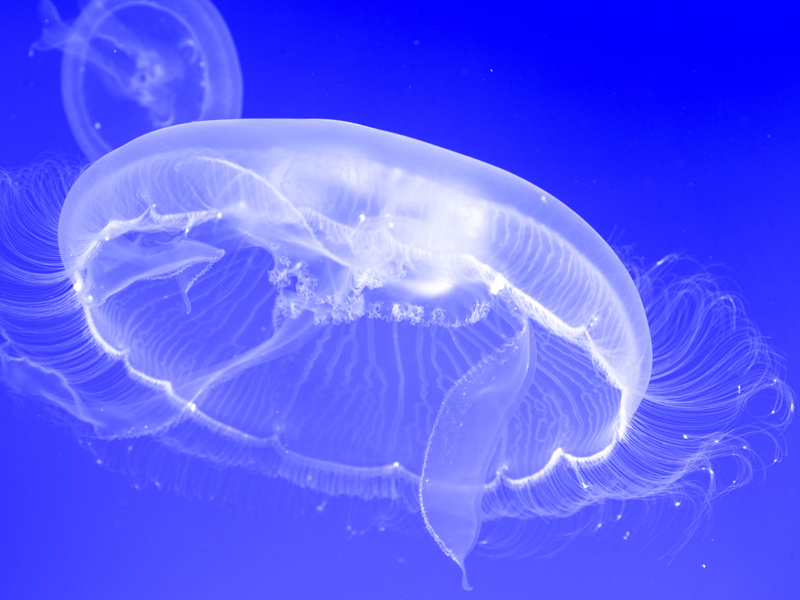
Tucked away in a nondescript room just outside the public eye lies an impressive jellyfish production line. Ten tanks of various shapes and sizes, linked by PVC and plastic tubing, help keep this homemade marine ecosystem flowing. At the head of this set-up is Museum fish and invertebrate specialist Tom Fenske.
Fenske has 35+ years of experience working for aquariums from Florida to Waikiki, and 30+ working with jellies. While maintaining this ecosystem is demanding, it is also a highlight of his many duties at the Museum. “The jellyfish are very relaxing to look at … so relaxing you hardly remember you’re looking at them,” he says.
More specifically, these are moon jellyfish and they all derive from a group of polyps received by the Museum in 2012. Through a form of asexual reproduction called strobilation the polyps regularly produce ephyrae, or what Fenske calls “pulsing stars.”
The ephyrae are less than 1/8-inch to start, and resemble denuded umbrellas, with “spokes” that will form the frame of the bell and what looks like a “handle” that is a precursor to the four oral arms it will use to sweep food into its mouth.
The transformation from an ephyra to a fully formed jellyfish, or medusa, happens quickly, as transparent tissue begins to connect the spokes and form the bell over the next three weeks. Four months later, a medusa can be as big as a closed fist. Fully grown, they can be up to 16 inches in diameter.
Jellyfish are as delicate as they are beautiful. They consist almost entirely of water — estimates range from 95 to nearly 99 percent. The remaining percentage is devoted to reproductive organs and a digestive system. When jellyfish die, they essentially disintegrate. The only evidence that they have passed may be one less jellyfish in the tank.
The guts are colorful, and more noticeable, immediately after feeding. They resemble a four-leaf clover at the center of the bell, and for the roughly two hours it takes to digest their meal of tiny crustaceans, the cloverleaf takes on the food items’ orange/pink hue. The area then returns to a milky white in between meals.
With a twice-daily, 365-day-a-year feeding regimen, breeding the jellies’ live food on site is time consuming but critical. Near-microscopic rotifers (zooplankton), copepods and daphnia (small crustaceans), and copious amounts of tiny brine shrimp are all raised in separate tanks.
Visitors can see adult moon jellyfish medusae via a live Jelly Cam or in the Museum’s Investigate Lab jellyfish tank, which is specially designed with a circular current and rounded corners that limit potentially damaging contact with the sides. Even air bubbles can be dangerous or even deadly, as they can pass right through a jelly’s bell.
Despite all the hard work, the rewards are clear. “We’re showing something that a lot of people know about but may only see dead and washed up on the beach,” Fenske says. “This gives Museum visitors a chance to see moon jellyfish alive and in the water.”
For more information about our upcoming activities, conservation news and groundbreaking research, follow @NaturalSciences on Instagram and Facebook.