

New Fossil Discoveries from Brazil
March 04, 2026
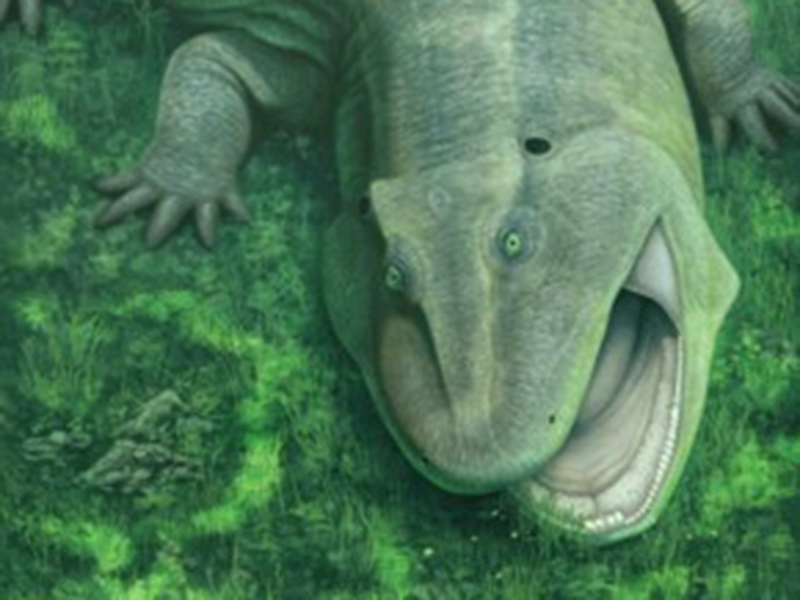
Newly published fossil specimens discovered by an international team of scientists, including the Museum’s Research Curator of Paleontology Dr. Christian Kammerer, are greatly expanding our knowledge of life at the ancient equator.
The early Permian Period, roughly 285 million years ago, was a time of change for life on Earth: increased glaciation at the South Pole had caused the downfall of previously cosmopolitan “coal swamp” environments, giving way to drier climates and new ecosystems.
Prominent in these ecosystems were the amniotes, fully land-living animals with a shelled egg that meant, unlike amphibians, they did not need to return to the water to reproduce. Living amniotes include reptiles, birds and mammals, and the ancestors of these groups are represented in the Permian fossil record.
Historically, the early Permian record of land animals was restricted to a set of rocks from the American Southwest, Appalachia and Central Europe, and what was happening on the southern continents at this time was largely unknown. However, recent fieldwork in the Pedra de Fogo Formation of northern Brazil, led by Dr. Juan Cisneros of the Universidade Federal do Piauí, has provided a valuable window into life in the tropical Permian just south of the equator.
Early Permian Synapsids
Two papers published in the past two weeks present strongly contrasting aspects of the Pedra de Fogo ecosystem. The first presents the first record of early Permian synapsids from South America. This group represents the ancestors of mammals and are well-represented globally in the later Permian and Triassic. Based on their abundance in early Permian rocks of Texas and Oklahoma, scientists expected that they should be present in southern hemisphere ecosystems as well, but their fossils remained elusive.
The first clue to their presence was the impression of a single vertebra (part of the backbone) found by Kammerer during a mid-day break — temperatures in this part of Brazil are so extreme (up to 120º F) that for health reasons it is necessary to enforce a “siesta” period when the scientists are not actively hiking and digging.
Hunkering down over a pile of rock fragments in the quarry, he spent hours carefully flipping each one over, looking for evidence of fossils and eventually finding half of a “mold” — the hollow left over from a bone that later dissolved. This bone looked different from the usual fish and amphibian vertebrae that are common at the locality, suggesting that it could represent an amniote.
Confirmation that amniotes (and specifically synapsids) were present came with the subsequent discovery of a maxilla (jawbone) showing the characteristic tooth structure of early synapsids. These finds demonstrate overlap between North and South American faunas in the early Permian, but the extreme rarity of synapsid fossils at the Brazilian sites suggest that the local environment was not ideal for them.
The Twisted Jaws of Tanyka
The second paper describes a new species of stem-tetrapod named Tanyka amnicola. The presence of a stem-tetrapod in this ecosystem at all came as a surprise — this group consists of animals occupying the branch of the family tree between fish and amphibians, whose best-known members such as Tiktaalik and Ichthyostega lived nearly 100 million years before Tanyka. Whereas the Pedra de Fogo synapsids are early records of a group whose heyday was still on the horizon, Tanyka was something of a relic.
“Tanyka is from an ancient lineage that we didn’t know survived to this time, and it’s also just a really strange animal. The jaw has this weird twist that drove us crazy trying to figure it out. We were scratching our heads over this for years, wondering if it was some kind of deformation,” says Dr. Jason Pardo of the Field Museum in Chicago, the study’s lead author. “But at this point, we’ve got nine jaws from this animal, and they all have this twist, including the really well-preserved ones. So it’s not a deformation.”
The twisted jaws of Tanyka are indicative of an unusual feeding style, unique among creatures known at its time. The surface of Tanyka’s jawbone is covered in a series of smaller teeth called denticles, which form a grinding surface sort of like a cheese grater. Scientists have yet to find the bones that would make up Tanyka’s upper jaw, but they imagine its top teeth and denticles were oriented similarly to the ones on the lower jaw.
“We expect the denticles on the lower jaw were rubbing up against similar teeth on the upper side of the mouth. The teeth would have been rasping against each other, in a way that’s going to create a relatively unique way of feeding,” says Pardo. In general, teeth that are able to grind against each other are used for crushing up plant material. “Based on its teeth, we think that Tanyka was a herbivore, and that it ate plants at least some of the time,” says Cisneros.
The researchers say that it’s surprising that a stem-tetrapod like Tanyka would have evolved to eat plants, since most of its fellow stem-tetrapods only ate meat. “It indicates that even though Tanyka was part of an archaic group, it’s not like these were static and unchanging,” says Kammerer. “They were still evolving and playing important roles in their ecosystems, even if they didn’t end up surviving to the present day.”
For more information about our upcoming activities, conservation news and groundbreaking research, follow @NaturalSciences on Instagram and Facebook.