

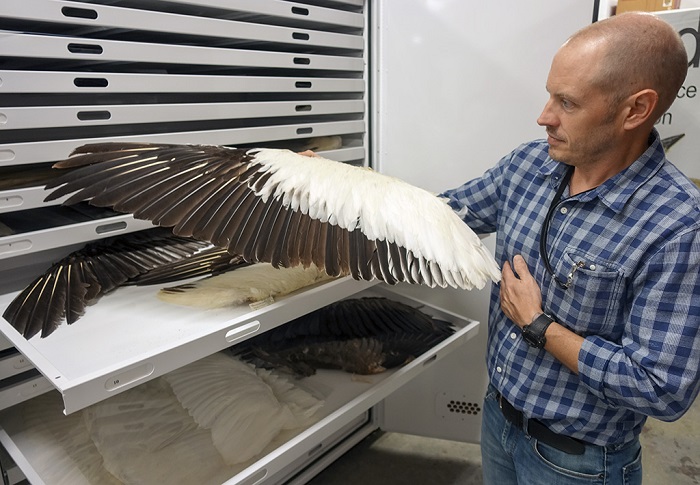
O’Shea holds a large seabird wing. NCMNS has one of the largest seabirds specimen collections in the world.
Join us for Ornithology Research Day! This event will highlight active research projects happening across North Carolina and beyond. Ornithologists and other bird enthusiasts from the Museum and beyond are excited to chirp their wisdom about the fascinating world of birds.
Exhibits- 1st Floor, Nature Research Center
Life on the Wing: Exploring the World of Purple Martins
NC Purple Martin Society
This exhibit introduces visitors to the fascinating world of purple martins including their life cycle, behaviors, and the challenges they face. You’ll also learn how scientists study their seasonal migrations and feeding habits. The table will feature hands-on activities for children and engaging information for adults, making it an educational stop for all ages.
North Carolina Mini Breeding Bird Survey & Caterpillars Count!
Hurlbert Lab at UNC Chapel Hill
Caterpillars Count! is a citizen science project for measuring the seasonal variation, also known as phenology, and abundance of arthropods like caterpillars, beetles, and spiders found on the foliage of trees and shrubs.
Bird Conservation at the North Carolina Zoo
North Carolina Zoo
The mission of the North Carolina Zoo is to conserve wildlife and their natural habitats. This exhibit will feature the Zoo’s regional and international conservation efforts focused on birds. Locally, the Zoo protects and manages land, installs glass mitigation to prevent bird collisions, and contributes to citizen science projects. Globally, the Zoo and partners protect endangered African vultures and work to prevent the extinction of native bird species in the Mariana Islands.
Get to Know the Cape Fear Bird Observatory
Cape Fear Bird Observatory
Come meet the Cape Fear Bird Observatory! Founded in 2020, we are actively working to better understand the avian communities of the Cape Fear region. To do this we are monitoring migration, studying regional species, collaborating with environmental groups, and exploring the outdoors with local school children. Through these endeavors, we engage people of all ages and backgrounds in the importance of the wonderful wildlife and habitats the Cape Fear region has to offer. We are excited to hang out with our collaborators at the Museum and to tell folks from the Triangle what is happening in the southeast part of the state.
Bird Collections at the NC Museum of Natural Sciences
The NC Museum of Natural Sciences hosts a variety of collections of research-level specimens. These are used by scientists and artists from around the U.S. This event focuses on the Ornithology Unit, so we will showcase some of the variety of bird specimens we manage and describe some of the ways in which researchers use our materials. Our specimen types include traditional “skins”, bones, wings spread open, eggs, nests, and tissues. We will have on hand some specimens that can be safely handled by anyone (everyone loves an owl wing!).
Bird Tagging to Study Live Birds
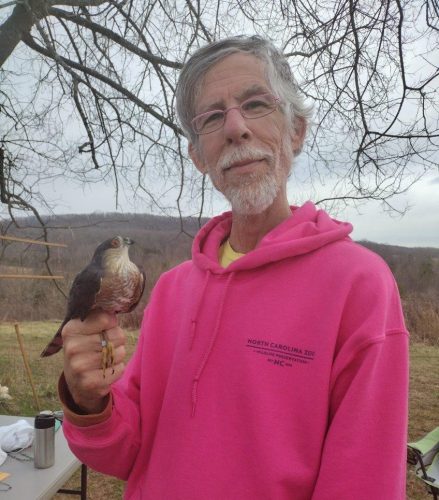
There are a variety of techniques that researchers can use to trap, tag, and release live birds in order to study their movements and learn more about their life cycles. Our station will showcase some of the tagging methods we use, along with examples of results we’ve obtained in our studies of NC birds. We will have specimens on hand – seeing these up close helps to visualize how the tagging works for different sized birds.
A Study of NC Sparrow Chromosomes
Presentations- SECU Daily Planet Theater
12:00pm
John A. Gerwin
Research Scientist, Educator, NC Museum of Natural Sciences
Bird studies of the NC Piedmont
The Piedmont of NC is home to many species of birds. Some live here all-year, whereas others are migrants. Some migrants come here to nest, others come here to spend the winter; some are just passing through. John has studied a number of these species, using various tag/track methods. He will highlight a few species and tracking techniques used to study how some birds “make a living”.
About John:
John began watching birds at about age 4 (so said his mother). He learned to stuff birds during his high school years. He then attended the University of Minnesota and spent all his free time at the Bell Museum on campus. He then headed down the Mississippi to do graduate work at Louisiana State University. He has worked at the NC Museum of Natural Sciences for over 38 years.