

About Us

Open Minds: Teen Science Cafés

Applications for the 2013-2014 Teen Advisory Board are now online!  The Teen Advisory Board is a unique opportunity for students to contribute their voice as the Museum explores ways to connect teens with science learning and research.  Members are the driving force behind planning, publicizing, and hosting the Open Minds Teen Science Cafes.  More information and application form.

Applications are due to Lynn Cross (lynn.cross@naturalsciences.org) by May 15th at 5pm.


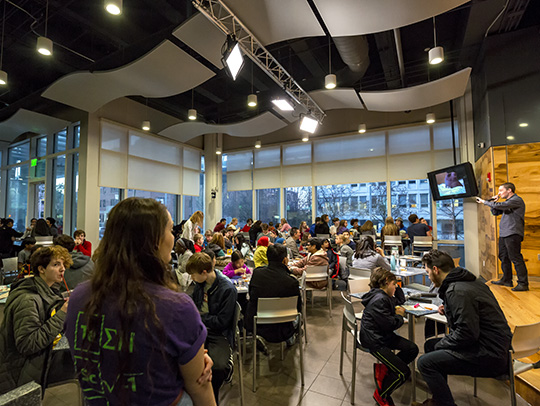
Calling all teens! Starting again in October, come to the Museum on First Fridays, 6-7pm, for our FREE Open Minds: Teen Science Cafés.

Location: The Daily Planet Café in the Nature Research Center at 121 West Jones St, Raleigh. 

Free meal or smoothie to first 50 teens to arrive. Teens are encouraged to arrive at the Daily Planet Café by 5:30pm to claim and redeem their free food.

Like the Teen Science Cafés on Facebook.

Upcoming Cafés

Open Minds Teen Science Cafes are over for the 2012-2013 school year, and will resume in October 2013. Thanks for your interest, and we'll see you in the fall!

Past Cafés

May 3, 2013

Simple Rules to Move By: Coordinated Movement in Groups of Animals and Teenagers

New research on animal movement is revealing how the amazing coordinated movements of animal groups, such as schools of fish or flocks of birds, are an emergent property of each individual following a few simple decision rules. At our May 3rd Open Minds Teen Science Café, Dr. Roland Kays will review these recent findings, and explain how he is testing some of these results in primates, for the first time, with a new baboon tracking program in Kenya. Then, he will lead us through an exercise to see if we can use flocking behavior like animals to effectively move through space and avoid predation!

About the Speaker

Dr. Roland Kays is the Director of the Museum’s Biodiversity and Earth Observation Research Lab.  He is also a Professor in the Fisheries, Wildlife & Conservation Program at NC State University, and a Research Associate at the Smithsonian.  Roland is interested in how, where, and why animals move, and his research typically involves bringing the latest technology into the wild parts of the world to discover new things. His work has allowed him to explore tropical rainforests, African savannas, and suburban woodlots.  His primary expertise is with mammals, and he has published papers on lions, coyotes, sloths, agoutis, ocelots, and kinkajous.  However, he feels that any species can lead to good research if the scientific question is interesting, and he has also worked on toucans, egrets, orchid bees, and even the movement of plant seeds.  His field work often involves running around in the woods chasing after animals, and to stay in shape between projects he plays ultimate Frisbee, rides off-road unicycles, and tries to keep up with his two young sons.

April 5, 2013

Plague:  New Lessons from an Ancient Disease

At our April Open Minds: Teen Science Café, Dr. Bill Goldman from the University of North Carolina will talk about plague, the deadly disease that changed the course of European history during the Middle Ages.  Why do scientists continue to study this disease, and what can it tell us about the evolution and emergence of highly virulent pathogens?  Dr. Goldman will provide insight into modern research on the bacterium Yersinia pestis and how we can continue to learn about new diseases by understanding old ones.

About the Speaker

Bill Goldman is Professor and Chair of Microbiology and Immunology at the University of North Carolina at Chapel Hill.  Prior to that appointment in 2008, he was on the faculty of Washington University in St. Louis for 25 years.  His laboratory’s research focus has been on the pathogenesis of several infectious respiratory diseases, including histoplasmosis, pertussis, and pneumonic plague.  With interests spanning both fungal and bacterial pathogens, Dr. Goldman has served as Editor of the journal Molecular Microbiology (2001-2008) and has also been elected to chair conferences on microbial pathogenesis, including a FASEB Summer Research Conference (2000) and a Gordon Research Conference (2002).  He is a Fellow of the American Academy of Microbiology (since 2002) and a Fellow of the American Association for the Advancement of Science (since 2012).  Dr. Goldman enjoys talking about his lab's research and has been invited to give more than 200 lectures at international conferences, research institutions, and regional meetings in the U.S. and 16 other countries.

It was a high school biology course that got Dr. Goldman fascinated with microbiology, and this interest grew in college (at Indiana University in Bloomington) and graduate school (at UNC-Chapel Hill).  He is excited to be back in North Carolina, though he misses Major League Baseball and his beloved Cardinals.  His wife, Virginia Miller, is also a microbiologist at UNC-Chapel Hill, and he has a college-age daughter who is firmly committed to a non-science career.  Dr. Goldman plays ragtime and classical piano, and he enjoys photography, bicycling, and making pizza from scratch every weekend.

March 1, 2013

WAAZM Adventures of a Museum Veterinarian

In the vast field of veterinary medicine, WAAZM is the acronym for Wildlife, Avian, Aquatics & Zoo Medicine, and it refers to all the critters that fly, swim, creep, crawl, prowl or prance across any given habitat in the wild or in a zoo. Join Museum veterinarian Dr. Dan Dombrowski for a fun review of veterinary medicine as it applies to this diverse group of animals. We will discuss the similarities and differences between common and unusual species and review real strange and bizarre cases such as surgery on a fish in the water and exoskeletal repair of a millipede. Then we will test your animal knowledge with a trivia game!

About the Speaker

Dr. Dombrowski is currently the chief veterinarian at the North Carolina Museum of Natural Sciences (NCMNS) and Adjunct Faculty at the North Carolina State University (NCSU) College of Veterinary Medicine. He grew up in Hampton, Virginia, where he met his wife of over 20 years and best friend in high school biology class. They now have 2 great kids and lots of pets, and have lived in Raleigh since 1998.

From 1990 to 1996, Dr. Dombrowski attended Virginia Commonwealth University, where he earned his Bachelor’s and Master’s degrees in Biology.

Dr. Dombrowski then worked for eight years as a Research Laboratory Technician in a pharmacology lab at the Medical College of Virginia and for three years at the Museum as Curator of the Tropical Conservatory. From 2002 to 2006 he attended vet school and earned his D.V.M. from NCSU. In 2006, he received the Wildlife, Avian, Aquatic, and Zoological Medicine (WAAZM) Proficiency in Zoological Medicine Award.

Dr. Dombrowski has been an author and coauthor of several publications in pharmacology, natural history, and two book chapters focusing on invertebrate medicine. His interests include wildlife health and conservation, science education and veterinary medicine. He also enjoys collecting geodes and building with Star Wars Lego kits.

February 1, 2013

Assembling the Tree of Life 

How do we know birds are modern-day dinosaurs?  At our February Teen Science Café, Dr. Daniel Ksepka from the National Evolutionary Synthesis Center in Durham will talk about how scientists reconstruct evolutionary trees using the physical characteristics of organisms, and then we will try our hands at creating a tree for a set of mysterious metal organisms.

About the Speaker

Dr. Daniel Ksepka is a paleontologist at the National Evolutionary Synthesis Center on Duke Campus. He grew up in New Jersey, home of the first American dinosaur skeleton, and studied geology at Rutgers University as an undergraduate. Later, he earned a PhD in paleontology at the American Museum of Natural History, where he counted himself among the luckiest people in the world to walk past a giant millipede, a life-size blue whale model, and the original Tyrannosaurus rex skeleton every morning on the way to his office.

Dr. Ksepka's research focuses on the evolution of birds, and has brought him to Peru, South Africa and New Zealand in search of new fossils. In the past few years, he has taught classes in paleontology and evolution at North Carolina State University. Many NCSU students have worked in his lab and have discovered giant fossil turtles, created rapid prototypes of extinct bird brains, and surveyed the microscopic structure of fossil penguin bones. In his spare time, Dr. Ksepka enjoys bird watching, grazing his pet tortoises and rooting for the New York Giants. You can learn more about Dr. Ksepka's research at his blog "March of the Fossil Penguins" and you can follow him at KsepkaLab on Twitter.

January 4, 2013

What’s in My Water?

At our January Teen Science Café, Dr. Heather Patisaul from North Carolina State University will talk about where our drinking water comes from, the difference between tap and bottled water, the pros and cons of the different types of containers our water comes in, and the environmental and health impacts of our water consumption choices.  Then, we will put your taste buds to the test in blind taste-tests to see if you can tell the difference between different types of water and liquids stored in different types of containers.

About the Speaker

Heather Patisaul is an Associate Professor of Biology at NC State University. She grew up on the beaches just south of the Kennedy Space Center in Florida, and got her Bachelors in Zoology at the University of Florida.  She then got her Ph.D. in evolution and ecology at Emory University in Atlanta, and did field work with lemurs in Madagascar before moving to North Carolina.  She has always been interested in how our environment, from what we eat, to what we drink, and how we live, shapes our brain and behavior.  She is also very concerned about how human activity impacts the planet and the environment.

Her current work explores the potential health consequences of exposure to chemical contaminants such as plasticizers and flame retardants, found in our homes, food and water.  Heather is also an avid runner, and her first race of 2013 will be the Krispy Kreme Challenge. Last year she managed to eat only one doughnut.  This year she’s hoping to double that rate of consumption, and still finish ahead of her 13 year old son without getting sick.

November 2, 2012

Looking for Life in Outer Space

Dr. Rachel Smith, Director of the  Astronomy & Space Observation Research Laboratory at the Nature Research Center and Assistant Professor at Appalachian State University. Tour of astronomy exhibits to follow. 

October 5, 2012

What Makes a Zebrafish Nervous?

Fear, anxiety, and stress responsiveness in animals, just in time for the most fearful month of the year. NC State University Department of Zoology professor Dr. John Godwin. 

September 7, 2012

Going, Going, Gone?

Status of Earth’s rainforests, what teens can do to help conserve them, and methods scientists use to delve into their secrets.  Nature Research Center director “Canopy” Meg Lowman, a pioneer of tree-top exploration and conservation.

About the Cafés

Open Minds: Teen Science Cafés are funded by a grant from the National Science Foundation with additional support from Time Warner Cable. Not only are these science cafés specifically targeted toward teenagers, but the Museum’s Teen Advisory Board will select topics and speakers for these cafés and will be instrumental in their implementation. 

Open Minds: Teen Science Cafés will also be hosted by teen groups in Chapel Hill in collaboration with Morehead Planetarium and Science Center, and in Whiteville at the Museum of Forestry as part of building a regional café network. 

These programs are part of a network of teen science cafes across the country funded by a grant from the National Science Foundation.

  Time Warner Cable logo

Publish Date: 
Thursday, August 30, 2012